Pad Nam Man Hoy at a glance
| Question | Answer |
|---|---|
| What is it? | A Thai stir-fry seasoned with oyster sauce, ผัดน้ำมันหอย. |
| What does it taste like? | Savoury and lightly sweet. The heat depends on the recipe. |
| Which meat is in the recipe? | Beef fillet, with onion, straw mushrooms and spring onion. |
| Can it be plant-based? | Use a suitable plant-based stir-fry sauce and check the rest of the ingredients. |
| What goes with it? | Plain jasmine rice works well with the glossy sauce. |
| Where can I order it? | See Oyster Sauce Stir-Fry in Doncaster for the restaurant version. |
For more dishes and how they differ, see the guide to Thai food.
What Pad Nam Man Hoy means
ผัดน้ำมันหอย describes stir-frying with oyster sauce. Pad is the cooking method. Nam man can mean oil, and hoi refers to shellfish in this compound. Read nam man hoi together as oyster sauce. Nuea means beef, moo means pork and gai means chicken. T1 T3 T4 E2 E5
Nua Pad Nam Man Hoy and Nuea Pad Nam Man Hoi both refer to the beef dish. Pad Nam Mun Hoy is another spelling of the base name. E5 E6 E7
Pholfoodmafia describes its beef version as a dish served in Thai-Chinese restaurants. The sources show different ways of preparing it, from Phol Tantasathien’s two-stage beef method to a pork stir-fry cooked in one pan. They leave its earliest maker and date open. T1 T3
The sauce gives this stir-fry its identity. In Pad Khing, ginger leads the flavour. Pad Kratiem puts garlic and pepper first.
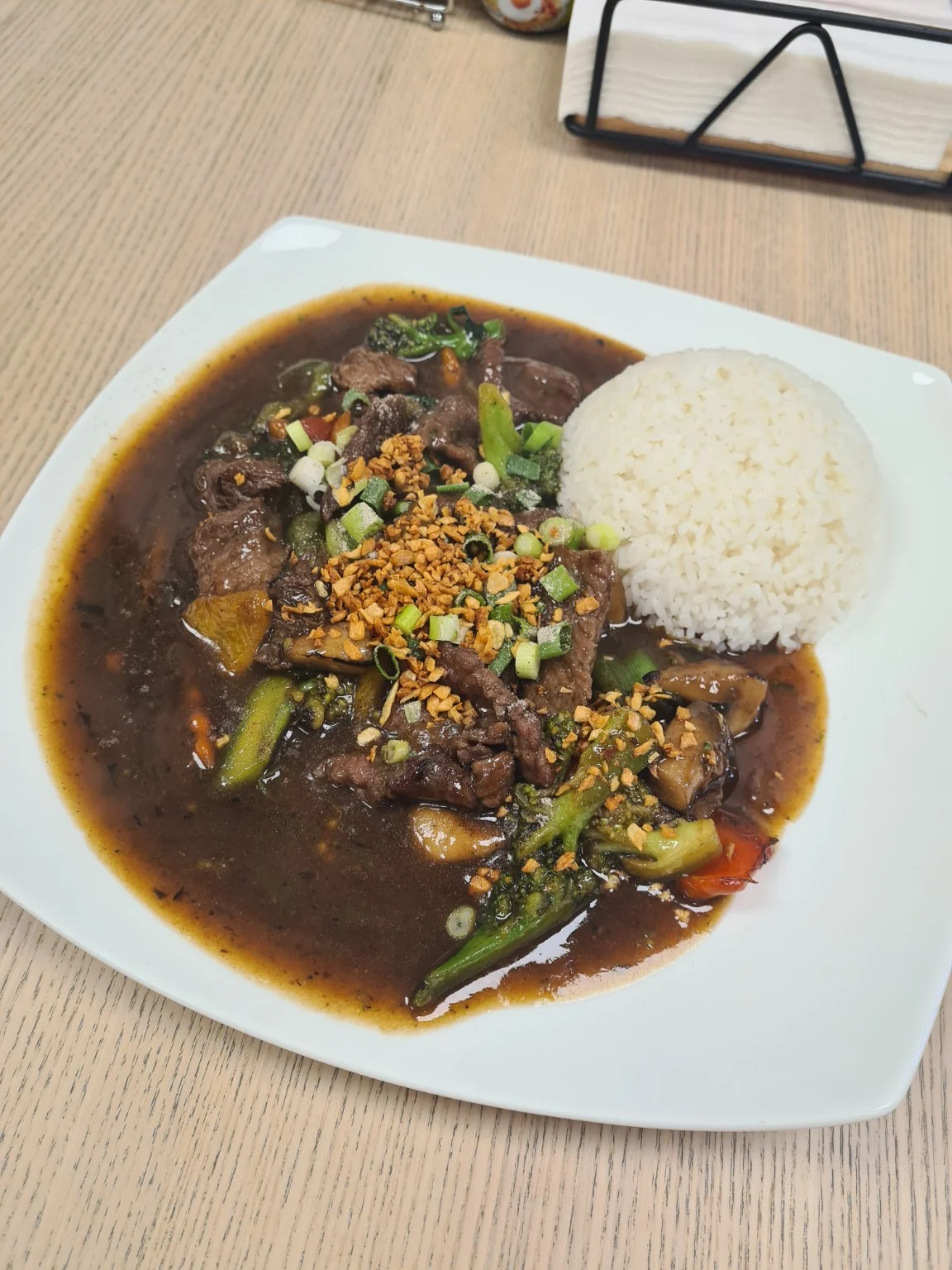
Choosing oyster sauce, beef and vegetables
Conventional oyster sauce is a thick, savoury seasoning made with oyster ingredients. It coats the food as you toss it. A plant-based mushroom stir-fry sauce can serve a similar purpose, with its own flavour and ingredient list. E4 U5
| Ingredient | Role | What to look for |
|---|---|---|
| Beef fillet | Tender slices for a quick finish in the wok. | Cut across the grain so the slices are easier to chew. T1 T2 |
| Oyster sauce | The main savoury seasoning. | Check for molluscs and read the full ingredient list. E4 U5 |
| Light soy and seasoning sauce | Season the marinade. A little extra light soy goes into the wok. | Read both labels for soya, wheat and any other ingredients you need to avoid. T1 U4 |
| Potato starch | Coats the sliced beef before cooking. | Use potato starch. Cornflour is a separate home substitution if needed. T1 |
| Onion, straw mushrooms and garlic | Provide sweetness, bite and aroma. | Drain tinned straw mushrooms before using them. T1 |
| Shaoxing rice wine and chilli | Give this recipe its own aroma and heat. | For a preparation without wine, Nigel Wakelen has a separate beef version. T1 E1 |
Cut and measure everything before turning on the heat. The second stage moves quickly once the onion and mushrooms are in the wok. T1
Thai beef in oyster sauce recipe
Adapted from Phol Tantasathien’s Thai-language Pholfoodmafia recipe. It starts the fillet in cool oil, then finishes it over high heat. The source gives 400 g of beef and a 15-minute marinade. Use a 15 ml tablespoon, a 5 ml teaspoon and a 240 ml cup. The safe handling and probe guidance are additions for home cooks. T1 U1 U2
Ingredients
- 400 g beef fillet, sliced evenly across the grain
- 1 tbsp light soy sauce and 1 tbsp Thai seasoning sauce
- 1 tbsp potato starch
- 1 tbsp rice bran oil for the marinade and 240 ml for the first cooking stage
- 100 g onion, sliced, and 100 g straw mushrooms, halved
- 1 tbsp chopped garlic and 1 long red chilli, cut diagonally
- 4 tbsp oyster sauce, 1 tsp granulated sugar and 2 tsp light soy sauce
- ½ tsp coarsely ground black pepper and 1½ tbsp Shaoxing rice wine
- 2 spring onions, cut into short lengths
Method
- Marinate the beef. Toss the slices with the first measures of light soy, seasoning sauce and potato starch. Mix in 1 tbsp rice bran oil. Cover and refrigerate for 15 minutes.
- Start the beef in cool oil. Add the remaining measured oil to a deep, stable wok or pan, then add the beef before heating. Heat it until the beef is partly cooked and starting to turn opaque. Lift the beef out with a slotted spoon into a separate bowl. Have everything ready so it can finish cooking straight away.
- Prepare the wok for the finish. Take the pan off the heat and safely remove most of the oil with a ladle into a heatproof container. Leave about 1 tbsp in the wok. Return to high heat and stir-fry the onion and mushrooms, then add the garlic, beef and chilli.
- Season and cook through. Add the oyster sauce, sugar, second measure of light soy, black pepper and rice wine. Toss the beef and vegetables until the sauce coats them and the beef is cooked through. A clean food probe can check a thick piece. One Food Standards Agency combination is 75°C held for 30 seconds. U1
- Finish with spring onion. Toss it through, take the wok off the heat and serve. Plain jasmine rice is a serving suggestion.
Keep raw beef and the bowl used for the part-cooked meat away from cooked food. Use a fresh serving dish. The recipe includes conventional oyster sauce, light soy and rice wine. Check the labels of all prepared seasonings for the people eating. T1 U1 U4 U5
Other ways to cook oyster sauce stir-fry
| Version | What changes | What to follow |
|---|---|---|
| KRUA.CO sirloin | Uses a longer marinade with bicarbonate of soda, and adds ginger. | Use its own sirloin method and seasoning. T2 |
| Nigel Wakelen’s beef | Uses flank steak, button mushrooms, baby corn and mangetout, with oyster sauce and fish sauce. | The beef goes into hot oil and returns to the wok near the end. E1 |
| Tikky’s pork | Uses pork collar, garlic, oyster sauce and seasoning sauce. | Cook the pork through and finish with the spring onion and coriander. T3 U1 |
| Chef Peach’s chicken | Uses chicken thigh, fresh chillies and its own soy and fish sauce mix. | Follow the chicken method and cook the meat through. E2 U1 |
| Pailin’s Chinese broccoli | Cooks the stems first, then tosses in the leaves with sauce. | Serve as a side. Choose a suitable plant-based sauce if needed. E3 E4 |
Some versions put the meat in a hot pan and use a smaller measure of oil. Use the recipe written for that method so the cut, sauce and cooking order make sense together. T1 E1
60 Pad Nam Man Hoy questions answered
Open a question, use the topic links or show all the answers.
- Name and flavour
- Oyster sauce and seasonings
- Beef and preparation
- Vegetables and aromatics
- Wok technique
- Chicken, pork and other versions
- Allergy and dietary checks
- Serving and ordering
- Fixing problems
- Food safety and leftovers
Name and flavour
1. What is Pad Nam Man Hoy?
2. What does Pad Nam Man Hoy mean?
3. How do I pronounce Pad Nam Man Hoy?
Say roughly “pat nahm mahn hoy”. This is an English sound guide that leaves out Thai tones. T4
4. Are Pad Nam Mun Hoy and Pad Nam Man Hoi different dishes?
5. What does Nuea Pad Nam Man Hoi mean?
Nuea means beef. The rest of the name describes the stir-fry and its oyster sauce. E5
Oyster sauce and seasonings
7. What does oyster sauce contribute?
8. Is oyster sauce the same as fish sauce?
9. Do I need fish sauce for the home recipe?
The beef recipe on this page gets its seasoning from oyster sauce, light soy and seasoning sauce. Use its own measurements. T1
10. Why are light soy and seasoning sauce listed separately?
11. Should I add dark soy sauce for colour?
Beef and preparation
13. Which cut of beef is in the home recipe?
14. How should I slice the beef?
15. How long does the beef marinate?
16. What does the starch do in the marinade?
It gives the beef a light coating. The recipe uses potato starch, which is distinct from dried potato flour. T1
17. Can I use sirloin or flank?
Vegetables and aromatics
19. Which mushrooms are in the recipe?
20. Can I use tinned straw mushrooms?
Yes, as a practical adaptation. Drain them well first so the liquid from the tin stays out of the wok. T1
21. Can I add baby corn or mangetout?
Yes. Nigel Wakelen uses both with mushrooms and other vegetables. Keep the pieces small enough for brief stir-frying. E1
22. Does the main recipe include ginger?
23. What is gai lan?
Gai lan is Chinese broccoli. In Pailin Chongchitnant’s separate oyster sauce recipe, the stems go into the pan before the leaves. E3
24. When do I add spring onions?
Phol Tantasathien tosses them through just before taking the pan off the heat. The brief finish keeps them fresh-tasting. T1
Wok technique
25. Why does the recipe start the beef in cool oil?
That is Phol Tantasathien’s two-stage technique. The beef starts cooking gently, then finishes quickly in the wok with the vegetables and seasoning. T1
26. Can I use a frying pan?
27. Should the beef be fully cooked before lifting it out of the oil?
28. Why do onion and mushrooms go in before garlic?
The source gives onion and mushrooms the longer cooking time. Garlic goes in once they have softened, just before the beef and seasonings are tossed through. T1
29. What can I use instead of Shaoxing rice wine?
Chicken, pork and other versions
31. Can I make it with chicken?
32. Can I use pork?
33. Can I use prawns?
34. Can I make it with tofu?
Yes. Firm tofu is a practical home adaptation. If you want a plant-based meal, choose a suitable sauce and check every seasoning. E4
35. Can it be a vegetable side dish?
36. Is it the same as Pad Khing?
Pad Khing puts ginger at the centre. The main recipe here puts oyster sauce first. See our Pad Khing guide for a chicken and ginger preparation. T1
Allergy and dietary checks
37. Is conventional oyster sauce suitable for a mollusc allergy?
38. Is an oyster allergy the same as a prawn allergy?
Oysters are molluscs and prawns are crustaceans. They are separate allergen categories. Check for the specific ingredients you need to avoid. U5
39. Does the home beef recipe contain soya?
40. Is Pad Nam Man Hoy gluten-free?
41. How do I make a vegan version?
42. Is the home beef recipe halal?
Check the meat, sauces and preparation against your own requirements. The main recipe includes Shaoxing rice wine. T1
Serving and ordering
43. What rice goes with oyster sauce stir-fry?
Steamed jasmine rice works well with the savoury sauce. Charm Thai Cafe serves its stir-fry with jasmine rice. E3
44. What can I serve alongside it?
45. Can I prepare the vegetables in advance?
Yes. Cover and refrigerate prepared vegetables. Store raw meat separately in the fridge so its juices cannot drip onto produce or cooked food. U2
46. How does Charm Thai Cafe make its menu version?
The menu lists mixed pepper, carrot and spring onion in oyster sauce, with a choice of protein and jasmine rice. The home recipe on this page uses its own ingredients.
47. Can I ask for vegan or gluten-free preparation at Charm Thai Cafe?
The menu lists vegan and gluten-free preparations. Tell the team what you need before ordering so they can check the full dish. The shared kitchen handles allergens and cannot guarantee freedom from cross-contact.
48. Where can I see prices or order at Charm Thai Cafe?
See Oyster Sauce Stir-Fry in Doncaster for ordering information and the stir-fry menu for current choices.
Fixing problems
49. Why is the beef chewy?
50. Why did the vegetables turn soft?
51. Why is the sauce watery?
52. What if the stir-fry is too salty?
53. What if I want a milder version?
Choose a milder chilli or leave it out as a home adaptation. Black pepper still adds a little warmth. T1
54. Why has the garlic turned bitter?
Garlic can burn if it stays in a hot wok too long. In the beef recipe, it goes in after the onion and mushrooms so it cooks briefly. T1
Food safety and leftovers
55. How can I check that the meat is cooked through?
Use a clean probe in the thickest piece. The Food Standards Agency lists 75°C held for 30 seconds as one option. Cook chicken and pork thoroughly. U1
56. How long can I refrigerate the cooked stir-fry?
Cool it in smaller portions and refrigerate within one to two hours. Keep the fridge at 0°C to 5°C and eat the leftovers within 48 hours or freeze them. U2
57. Can I freeze the stir-fry?
Yes. Cool and freeze in portions, then defrost in the fridge. Use within 24 hours of fully defrosting. Some vegetables may soften. U2
58. How should I reheat the stir-fry?
Reheat only once, until steaming hot throughout. Stir during microwave reheating so the pieces heat evenly. U1
59. How should I store and reheat the rice?
Cool it quickly, ideally within an hour. Keep it in the fridge for no more than 24 hours, then reheat once until steaming hot throughout. U3
60. Can I give one calorie figure for Pad Nam Man Hoy?
A useful estimate needs the actual recipe and portion, including oil, sauce and any rice. The restaurant and home recipes have different ingredients.
Thai words you may see in recipes
These are approximate English sound guides. They leave out Thai tones.
| Thai | Approximate pronunciation | Meaning |
|---|---|---|
| ผัด | pat | Stir-fry |
| น้ำมันหอย | nahm mahn hoy | Oyster sauce |
| เนื้อวัว | nuea wua | Beef |
| สันใน | san nai | Tenderloin or fillet |
| หมู | moo | Pork |
| ไก่ | gai | Chicken |
| กุ้ง | gung | Prawn |
| เห็ดฟาง | het faang | Straw mushroom |
| กระเทียม | kra-thiam | Garlic |
| หอมใหญ่ | hom yai | Onion |
| ต้นหอม | ton hom | Spring onion |
| พริกชี้ฟ้า | phrik chee faa | Long chilli |
| พริกไทยดำ | phrik thai dam | Black pepper |
| ซีอิ๊วขาว | si-io khao | Light soy sauce |
| ซอสปรุงรส | sot prung rot | Seasoning sauce |
| แป้งมันฮ่องกง | paeng man hong kong | Potato starch in this recipe |
| เหล้าจีน | lao jeen | Chinese cooking wine |
| ข้าวสวย | khao suai | Cooked rice |
See the Thai recipe and dictionary entries for the terms in context. T1 T2 T3 T4
Pad Nam Man Hoy at Charm Thai Cafe
The menu calls it Classic Oyster Sauce Stir Fry. It is a mild, savoury stir-fry with mixed pepper, carrot and spring onion, served with jasmine rice. The restaurant guide covers available choices and ordering.
A vegan preparation is listed with vegan oyster sauce. For gluten-free requirements, ask the team to check the complete dish. Tell us separately about an allergy or coeliac disease before ordering. Our shared kitchen handles allergens including nuts, seafood, wheat and eggs, and we cannot guarantee freedom from cross-contact.
Sources and further reading
The Thai-language beef recipe supplies the main method. Other cooks show different sauces, meats and vegetables. Food safety and label guidance comes from the Food Standards Agency and Coeliac UK.
- T1. Phol Tantasathien, Pholfoodmafia stir-fried beef with oyster sauce. Main recipe, two-stage beef technique, quantities and Thai-Chinese restaurant context.
- T2. Napaporn Simanee, KRUA.CO stir-fried beef with oyster sauce. Separate sirloin recipe, cutting across the grain, longer marinade and ginger.
- T3. Tikky, Cookpad Thai pork stir-fried in oyster sauce. Pork collar, garlic, oyster sauce and seasoning sauce.
- T4. Longdo Dictionary, nam man hoi. Meaning of the complete Thai term for oyster sauce.
- E1. Nigel Wakelen, Beef in Oyster Sauce. Flank, vegetables and oyster and fish sauce in a separate hot-pan method.
- E2. ThaiChef Food by Chef Peach, Chicken Oyster Sauce. Separate chicken thigh preparation with chillies, soy and fish sauce.
- E3. Pailin Chongchitnant, Gai Lan Oyster Sauce Stir-Fry. Chinese broccoli, cooking stems before leaves and serving with jasmine rice.
- E4. Pailin Chongchitnant, Oyster Sauce 101. Oyster sauce uses, mushroom-based alternatives and bottle storage.
- E5. Ahaan Thai, Nuea Pad Nam Man Hoi. Beef dish spelling and translation of the name.
- E6. Hansa’s Thai Kitchen, published menu. Example of the Pad Nam Mun Hoy spelling and protein choices.
- E7. Frasers, published menu. Example of the Nua Pad Nam Man Hoy spelling.
- U1. Food Standards Agency, Cooking your food. Cooking through, probe temperature combinations and reheating.
- U2. Food Standards Agency, How to chill, freeze and defrost food safely. Raw meat separation, cooling, chilling, freezing and defrosting.
- U3. Food Standards Agency, Home food fact checker. Rice cooling, storage and reheating.
- U4. Coeliac UK, How to Read Gluten Free Food Labels. Ingredient and gluten label checks.
- U5. Food Standards Agency, Allergen guidance for food businesses. Molluscs, crustaceans and soya as separate allergen categories.