Green curry at a glance
The name tells you the colour of the paste, not how much heat you can handle. A pale green sauce can still carry plenty of chilli. Start with the paste and the recipe, then choose your protein and vegetables. T1 T11
| Question | Short answer |
|---|---|
| Thai name | แกงเขียวหวาน, gaeng kiew waan |
| Main sauce | Coconut milk with green curry paste |
| Green colour | Primarily fresh green chillies; some recipes add green herbs |
| Typical flavour | Spicy, savoury and rich, with gentle sweetness |
| Familiar vegetables | Thai aubergines, pea aubergines or bamboo shoots |
| Serving choices | Jasmine rice, khanom jeen noodles or roti |
| Dietary check | Check the paste, sauces, stock and preparation, not just the protein |
For the wider picture, our guide to Thai food compares curries with noodles, soups and stir-fries. If you want to order rather than cook, see green curry at Charm Thai Cafe.
Find what you need
What green curry should taste like
Coconut milk gives the sauce richness. The paste brings chilli and aromatics; fish sauce or another suitable seasoning supplies salt and savouriness. Palm sugar is used in many recipes, but sweetness should be judged against the whole sauce. Adding more sugar is not a substitute for balancing it. T10 E1
The literal name is “sweet green curry”. Thai PBS explains “sweet” as a description of its soft green colour. That does not mean the finished dish must be sugary. T2
A history with no single birthday
Green curry belongs to the central Thai coconut-curry tradition. Thai accounts connect it with red curry, using fresh green chillies in place of dried red ones. Recipes vary, including versions with beef, chicken, fish and other proteins. T1 T11
Thai PBS discusses an early twentieth-century development and later cookbook references. Those accounts do not establish one inventor or exact creation date. A precise origin story would sound tidy, but the available evidence does not justify one. T2
For the dried-red-chilli style, our red curry guide explains its paste and cooking method.
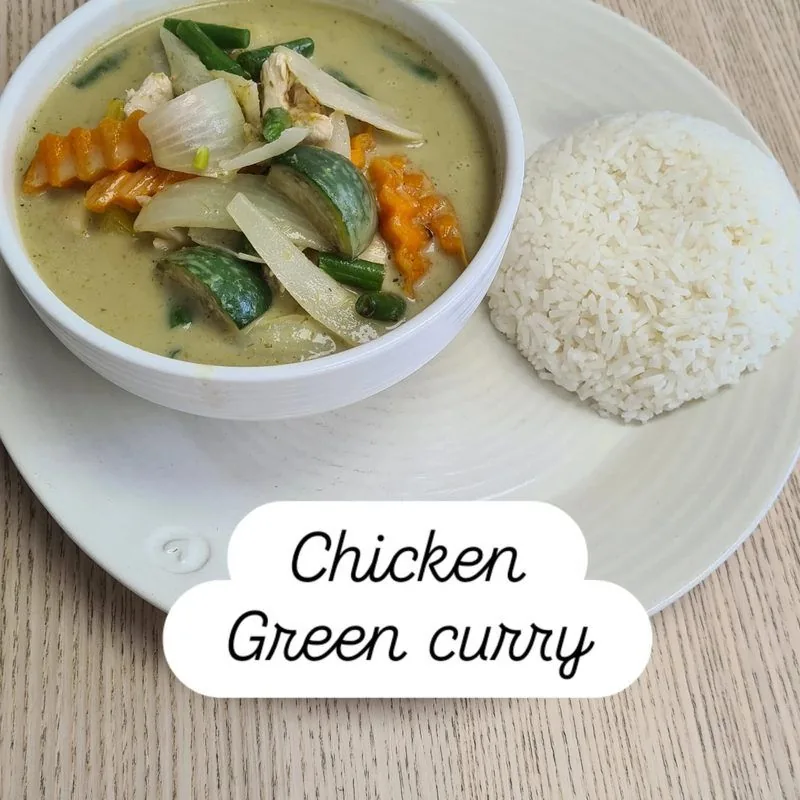
The ingredients and what each does
| Ingredient | Its role | What to check |
|---|---|---|
| Green curry paste | Chilli, herbs, spices and seasoning | Strength and salt vary. Many traditional pastes contain shrimp paste. |
| Coconut milk | The rich, pourable sauce | Full-fat milk suits these methods. Light versions change the texture. |
| Thai aubergines | Vegetables that cook in the sauce | Purple aubergine is used in a Thai prawn variation; cooking time changes. |
| Thai sweet basil | The herb added near the end | Ordinary basil changes the aroma. Holy basil is a different herb. |
| Makrut lime leaves | Citrus aroma in the sauce | Large pieces infuse the curry and are not intended to be eaten. |
| Galangal and lemongrass | Aromatics in the paste | Ginger is an adaptation for galangal, not the same ingredient. |
| Fish sauce | Salt and savoury seasoning | Use an appropriate animal-free alternative for vegan cooking. |
| Palm sugar | Balances the seasoning | Add according to the paste and your taste, not by habit. |
Thai ingredient and method references: T3 T9. Home substitutions and ingredient checks: E1 E2.
Prepared paste is a practical choice
You do not have to pound every paste yourself. Chef Nan’s Thai household recipe starts with bought paste and adds fingerroot and basil. The useful questions are what is in the paste, how strong it is and whether it suits the people eating it. T7
RecipeTin Eats and Hot Thai Kitchen recommend different brands. Treat those as their cooking preferences, not a universal ranking. Avoid transferring the quantity for a loose homemade paste directly to a concentrated commercial product. E1 E2
Thai green chicken curry: a home recipe
Adapted from Pholfoodmafia’s Thai-language My Cooking School booklet, page 6. This is a home-cooking adaptation, separate from Charm Thai Cafe’s restaurant recipe. The source uses its own homemade paste; commercial paste strength varies. T5
Suggested yield: 4 portions with rice. Use a deep saucepan or sauté pan. Portion yield is an editorial serving suggestion; no fixed cooking-time or calorie claim is made.
Ingredients
- 120g homemade green curry paste, or a prepared paste quantity according to its label
- 3 tbsp rice bran or neutral vegetable oil
- 400g chicken thigh, cut into bite-sized pieces
- 150g Thai aubergines, quartered
- 50g pea aubergines
- 400ml coconut milk
- 150ml water
- 1½ tbsp fish sauce, adjusted for the paste
- 1 tsp palm sugar
- 10 makrut lime leaves, torn
- 1 red and 1 yellow long chilli, sliced
- 20g Thai sweet basil leaves
- Jasmine rice, cooked separately, to serve
Method
- Cook the paste. Heat the oil over medium heat. Stir in the paste until fragrant, keeping it moving so it does not burn.
- Add the chicken. Stir the chicken through the paste, then add fish sauce. Hold back some sauce if your prepared paste is already salty.
- Build the sauce. Add both aubergines, coconut milk and water. Bring to a simmer, stirring to combine.
- Cook through. Simmer until the chicken is fully cooked and the aubergines are tender. Check the chicken with a clean probe: 75°C for 30 seconds, or an equivalent safe time and temperature.
- Finish and serve. Stir in sugar, torn lime leaves, sliced chillies and basil. Remove from the heat once the herbs wilt. Taste, adjust seasoning and serve with rice. Leave large lime-leaf pieces uneaten.
UK cooking-temperature guidance: U1. Large lime leaves are for infusion: E2.
Before cooking: this version includes fish and may include crustaceans in the paste. Check all product labels. For vegan preparation, change the paste, protein and seasonings together; adding tofu alone is not enough.
A homemade green curry paste option
Pholfoodmafia’s separate blender recipe uses the following batch. It makes more paste than one curry needs. This is a different source formulation from the cooking-school recipe above. Blend until fine; use the required amount and store any remainder according to safe ingredient handling. T4
| Quantity | Ingredient |
|---|---|
| 100g | large green phrik chi fa chillies |
| 70g | green Jinda chillies |
| ½ tbsp | roasted ground coriander seed |
| 2 tsp | roasted ground cumin |
| 15g | turmeric |
| 40g | Thai garlic |
| 40g | shallots |
| 15g | mature galangal |
| 20g | lemongrass |
| From 1 fruit | makrut lime peel |
| 30g | shrimp paste |
| 50g | whole coriander including roots |
| 100ml | water |
This is a hot paste containing shrimp. Reducing hot chillies changes its strength. For a vegan curry, use a verified animal-free paste instead. Follow packaged paste storage instructions; this guide gives no universal fridge life for homemade paste.
60 green curry FAQs
Choose a topic, open an answer or show all answers for reading and printing.
- Name and origins
- Taste, colour and heat
- Paste ingredients
- Choosing and making paste
- Cooking the curry
- Vegetables and protein choices
- Dietary questions
- Serving and other curries
- Solving cooking problems
- Nutrition, storage and ordering
Name and origins
1. What is green curry?
Green curry is a Thai curry made with coconut milk and a paste based on fresh green chillies. Chicken, beef, fish and other proteins appear in different versions. It is a curry style, rather than one fixed recipe. T1
2. What is green curry called in Thai?
The Thai name is แกงเขียวหวาน, commonly written gaeng kiew waan or kaeng khiao wan. Its literal translation is sweet green curry. Different English spellings refer to the same Thai name. T2
3. Does “sweet green curry” mean it should taste sugary?
No. Thai PBS explains the name through the soft green colour, rather than a requirement for a very sweet sauce. Coconut sweetness belongs in the balance; it should not erase the chilli and savoury seasoning. T2
4. Where does green curry come from?
5. Who invented green curry?
The sources reviewed do not establish a single inventor. Giving one chef, household or monarch sole credit would go beyond the evidence. Published recipes document the dish, but do not prove who first cooked it. T2
6. How old is green curry?
Thai PBS discusses an estimated early twentieth-century development and mentions cookbooks from 1941 and 1949. These are reported historical references, not a verified birthday. This guide does not assign an exact invention year. T2
Taste, colour and heat
7. What does Thai green curry taste like?
Expect chilli heat, coconut richness and savoury seasoning, with aromatic herbs. Thai descriptions include spicy, salty, rich and gently sweet flavours. The proportions vary, so two green curries need not taste identical. T10
8. Is green curry spicy?
It commonly contains hot fresh chillies and can be very spicy. The actual heat depends on the chillies, paste quantity and recipe. A pale sauce is not proof that the curry is mild. T11
9. Is green curry always hotter than red curry?
10. Can green curry be mild?
Yes, although a prepared paste already contains chilli. For homemade paste, use fewer hot chillies while retaining the aromatics. Reducing every ingredient together weakens the curry as well as reducing its heat. E1
11. Why is my green curry pale rather than bright green?
12. Should green curry have a thin or thick sauce?
It should be pourable rather than a dry coating. KRUA.CO describes a slightly thickened, glossy sauce. The liquid quantity varies between recipes, so use the consistency intended by your chosen method rather than reducing every curry to a paste. T11
Paste ingredients
13. What is in green curry paste?
Common ingredients include green chillies, shallots, garlic, galangal, lemongrass, makrut lime peel, coriander root, spices, salt and shrimp paste. The combination and quantities vary. Vegetarian pastes need a different formulation. T1
14. Which green chillies do Thai recipes use?
15. Does the green colour come mainly from Thai basil?
16. Does green curry paste contain turmeric?
17. Can I use ginger instead of galangal?
18. Are makrut lime leaves and lime peel interchangeable?
They are different ingredients. Several Thai recipes use peel in the paste and torn leaves in the curry. Leaves infuse the sauce; peel is pounded with the aromatics. Follow the recipe instead of swapping equal amounts without adjustment. T3
Choosing and making paste
19. Can I use green curry paste from a jar or tub?
Yes. Prepared paste is also used in Thai home recipes. Chef Nan’s household version starts with bought paste and adds herbs. Check the label for ingredients, allergens and cooking instructions before using it. T7
20. Which green curry paste brand is best?
21. How much green curry paste should I use?
Use the quantity for the particular paste and recipe. Homemade paste and concentrated commercial paste are not interchangeable gram for gram. Start with the maker’s guidance; taste the cooked sauce before deciding whether to add more. E2
22. How can I improve bought green curry paste?
23. Do I need a mortar and pestle?
Cooking the curry
25. Why fry green curry paste before adding the liquid?
26. What does splitting coconut milk mean?
In this context it means cooking coconut cream until some oil separates, then frying the paste in that fat. This intentional oil release is part of several Thai curry methods. It is different from judging whether stored food is safe. T12
27. Do I need to add oil?
28. Does green curry need chicken stock?
29. Should I use chicken thigh or chicken breast?
Both can be used. The home recipe in this guide uses thigh. Breast needs a method that avoids unnecessary simmering after it is cooked; Hot Thai Kitchen provides a separate breast method rather than treating both cuts identically. E2
30. How do I know the chicken is cooked?
Check the centre of a thick piece with a clean food thermometer. UK guidance gives 75°C for 30 seconds, or 70°C for two minutes, as safe combinations. A bubbling sauce does not establish the chicken’s core temperature. U1
Vegetables and protein choices
31. Which vegetables belong in Thai green curry?
Thai aubergines and pea aubergines are familiar choices. Thai sources also document bamboo shoots, long aubergines and coconut shoots. Green beans or other vegetables can be home adaptations; no single vegetable list covers every version. T10
32. What are the small green balls in green curry?
They may be pea aubergines, called makhuea phuang. Larger round Thai aubergines are makhuea pro. Both appear in Thai recipes. Identify unfamiliar ingredients with the cook rather than assuming every green piece is a pea. T8
33. Can I use bamboo shoots instead of Thai aubergines?
34. Can I make prawn green curry?
35. Can green curry be made with beef, pork or fish?
36. Can I make green curry with tofu?
Yes. Use tofu or bean curd skin with suitable paste, stock and seasonings. KRUA.CO’s vegan version uses bean curd skin and coconut shoots. Replacing chicken alone does not remove fish sauce or shrimp paste. T6
Dietary questions
37. Is green curry vegan?
It can be made vegan, but standard recipes often contain shrimp paste and fish sauce. Use a vegan paste, plant-based protein, suitable stock and animal-free seasoning. Check every ingredient, including additions used to enhance the paste. T6
38. Is a vegetable green curry automatically vegetarian?
No. A curry containing vegetables can still have fish sauce, shrimp paste or meat stock. Request vegetarian preparation for the complete dish. A vegan version also excludes ingredients such as dairy that a vegetarian may accept. T6
39. Is Thai green curry gluten-free?
A version can be made gluten-free, but check the labels on commercial curry pastes, stock, soy sauce and other seasonings. Read the full ingredients and allergen information each time; recipes can change. For restaurant food, discuss the complete preparation and shared-kitchen cross-contact. U4
40. Is coconut-milk green curry dairy-free?
Coconut milk is not dairy milk. However, dairy-free suitability depends on the full recipe: some adaptations use cream or other dairy ingredients. Check the ingredient list and tell the cook about a milk allergy separately. E1
41. Does green curry contain peanuts or other nuts?
The chicken recipe in this guide has no added peanuts, but that is not an allergy guarantee. Products and recipes differ; Pholfoodmafia even documents a cashew-milk version. Check the actual paste, sauce, garnishes and preparation. T13
42. Is green curry halal?
Suitability depends on the meat, paste, sauces, stock and preparation. At Charm Thai Cafe, halal chicken and beef are available; pork is also served. The restaurant is not halal-certified or wholly halal. Discuss the complete dish before ordering.
Serving and other curries
43. What rice goes with green curry?
44. Can I serve green curry with noodles?
45. Is green curry served with roti in Thailand?
Yes. Pholfoodmafia’s Thai cooking-school material lists roti alongside rice and khanom jeen. Check the roti ingredients if avoiding wheat or dairy; the curry’s dietary suitability does not establish the bread’s. T5
46. What is the difference between green and red curry?
Green paste uses fresh green chillies; red paste commonly uses dried red chillies. Many aromatics overlap. The distinction is more useful than assuming one colour guarantees a particular heat or sweetness. T11
47. How does green curry differ from Panang and Massaman?
Panang commonly has a more concentrated sauce. Massaman uses a different spice profile and often potatoes. At Charm Thai Cafe, Massaman paste contains roasted peanuts. Compare the actual ingredients rather than treating all coconut curries as interchangeable. T11
48. Is jungle curry green curry without coconut milk?
No. Jungle curry is a separate curry style with its own balance of herbs and seasoning. It is not defined simply by removing coconut milk from green curry. Our curry comparison explains the restaurant’s six styles. T11
Solving cooking problems
49. Why does my green curry taste bitter?
One cause to check is scorched paste. Keep it moving and reduce the heat if it catches. Once paste is burnt, adding sugar does not restore its original flavour. Start that stage again rather than hiding the bitterness. T7
50. Why does my curry taste weak?
Check paste strength and the amount of liquid. If it needs more paste, cook the extra paste separately before stirring it in. Simply adding fish sauce changes saltiness; it does not replace missing curry aromatics. E2
51. How do I avoid making green curry too salty?
52. Why is my green curry too sweet?
Check both the paste and the sugar you added. Use sweetness to balance the sauce rather than following one fixed amount with every brand. Taste before the final seasoning; a very sweet paste may need less extra sugar. E1
53. How can I thicken watery green curry?
54. What can I do if the finished curry is too spicy?
Add unseasoned coconut milk and more suitable ingredients to make a larger, milder batch, then check the seasoning. Serve extra rice alongside. Next time, adjust the hot chillies or paste before cooking; adding sugar does not remove chilli. E1
Nutrition, storage and ordering
55. How many calories are in Thai green curry?
There is no single figure. Coconut milk, oil, protein, portion size and rice change the total. Calculate the ingredients and serving weight of the actual recipe, or use the product’s label. We do not publish an unverified calorie figure for our restaurant curry.
56. Is green curry healthy?
That depends on the recipe, serving size and the rest of your diet. It can contain vegetables and protein alongside coconut milk and salty seasonings. A dish name cannot establish its nutritional balance, and this guide makes no medical claims.
57. How long does homemade green curry keep in the fridge?
Cool it promptly in smaller containers and refrigerate within one to two hours. Keep the fridge at 0°C to 5°C. UK guidance says eat leftovers within 48 hours or freeze them sooner; follow any stricter ingredient instructions. U2
58. Can I freeze green curry?
59. How should I reheat green curry and its rice?
60. Can I order green curry at Charm Thai Cafe?
Yes. Our green curry in Doncaster page explains the classic and Bangkok-style listings. Check the current menu, choose your protein and explain heat preferences and dietary requirements. For dine-in, Book a Table.
Choose green curry at Charm Thai Cafe
Our classic green curry lists coconut milk, green paste, bamboo shoots and Thai basil. Bangkok Style Green Curry is a separate menu listing. The Doncaster green curry page explains the choices; our Thai curry comparison helps you choose another style.
For vegan or gluten-free requests, discuss the complete paste, sauces and preparation before ordering. Tell us about allergies separately. Our shared kitchen handles wheat, seafood, egg, nuts and other allergens, and we cannot guarantee freedom from cross-contact. Read our vegan and gluten-free guidance.
Use the current menu for dishes, proteins and prices. For dine-in at Charm Thai Cafe in Doncaster town centre, booking is recommended.
Sources and further reading
Thai-language recipes and cultural accounts support the culinary sections. English-language cooking guides support practical substitutions; UK Food Standards Agency guidance supports food storage and cooking advice. Recipes differ, so examples are identified rather than presented as one compulsory formula.
- T1. Department of Cultural Promotion: แกงเขียวหวาน. Thai-language cultural record. Green chillies, paste aromatics, turmeric variation, proteins and serving traditions.
- T2. Thai PBS ALTV: 6 เรื่องราวเมนูอาหารที่คนทานไม่เคยรู้. Thai-language account of the name and historical uncertainty.
- T3. KRUA.CO / Sangdad Publishing: แกงเขียวหวานไก่. Thai-language chicken curry and pounded paste recipe, published 8 March 2018.
- T4. Pholfoodmafia / Phol Tantasathien: Chicken Green Curry. Thai-language blender paste and chicken curry. This is a different formulation from the cooking-school recipe.
- T5. Pholfoodmafia: My Cooking School, Fundamental Curry Paste 2. Thai-language teaching booklet. Home curry recipe adapted from page 6; ingredient quantities checked against the rendered PDF.
- T6. KRUA.CO: แกงเขียวหวานยอดมะพร้าวฟองเต้าหู้. Thai-language vegan curry featuring a plant-based paste, bean curd skin and coconut shoots.
- T7. KRUA.CO / Chef Nan: แกงเขียวหวานลูกชิ้นปลากราย เมนูรับแขกบ้านเชฟน่าน. Thai-language household method: prepared paste, fingerroot, basil colour and seasoning, 6 January 2025.
- T8. KRUA.CO / Chef Nan: แกงเขียวหวานลูกชิ้นปลากราย. Thai-language fish-ball curry with fingerroot, rice noodles and salted egg.
- T9. KRUA.CO / Charinrat Chingchit: แกงเขียวหวานกุ้งมะเขือม่วง. Thai-language prawn curry using purple aubergine and pea pods, 26 September 2019.
- T10. Doctor.or.th: แกงเขียวหวานไก่. Thai-language ingredient and serving overview, 1 May 2006. Its meal-specific nutrition figure is not used as a universal calorie count.
- T11. KRUA.CO / Nawara Plianbunlert: ถอดรหัสพริกแกงไทย. Thai-language comparison of curry pastes, consistency and aromatics, 18 September 2019.
- T12. Pholfoodmafia / Chef Thanakorn Ployseechomphu: Green Curry with Chicken Giblets. Thai-language coconut-cream frying method. The page also carries an English version.
- T13. Pholfoodmafia / Phol Tantasathien: Chicken Green Cashew Curry. Thai-language cashew-milk adaptation, 7 July 2017. Evidence of a variation, not the standard coconut recipe.
- E1. RecipeTin Eats / Nagi Maehashi: Thai Green Curry. English-language home-cooking substitutions and prepared-paste method.
- E2. Hot Thai Kitchen / Pailin Chongchitnant: Authentic Thai Green Curry Chicken. English-language guidance on paste strength, chicken breast, basil, lime leaves and substitutions. Text supplied by the owner.
- U1. Food Standards Agency: Cooking your food. UK cooking temperatures and reheating guidance.
- U2. Food Standards Agency: How to chill, freeze and defrost food safely. UK cooling, refrigeration, freezing and defrosting guidance.
- U3. Food Standards Agency: Home food fact checker. UK cooked-rice storage guidance.
- U4. Coeliac UK: How to read food labels. UK guidance on reading ingredient and allergen information, precautionary statements and checking labels when recipes change.