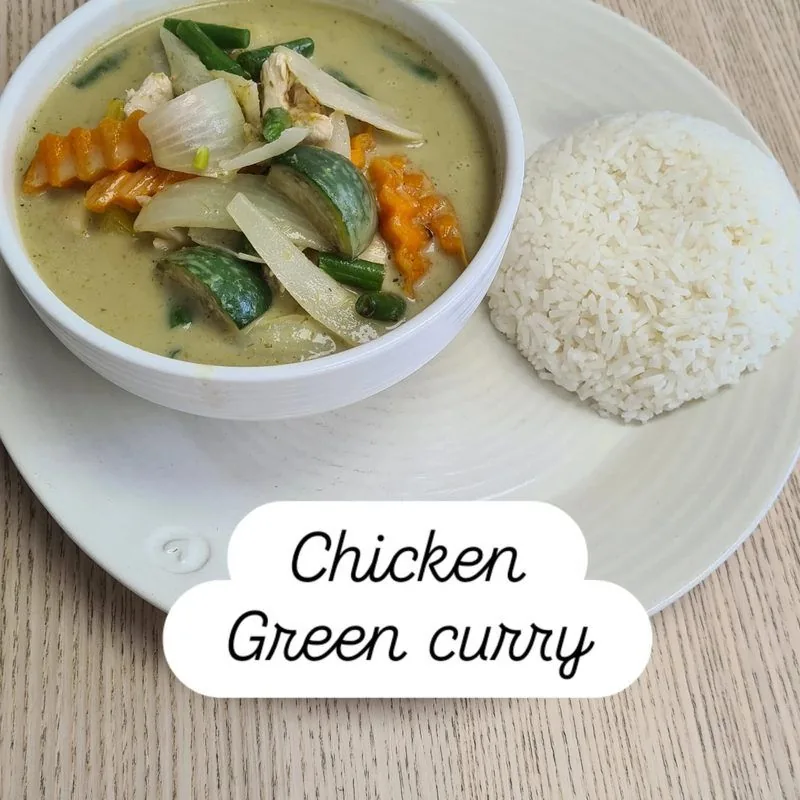
Types of Thai curry differ in paste, vegetables and sauce, not just colour. At Charm Thai Cafe, five classic styles use coconut milk; jungle curry does not. Compare the ingredients below, then choose the sauce and heat you enjoy.
Compare six classic curry styles
| Curry | What is in our version | A useful starting point |
|---|---|---|
| Green | Coconut milk, green paste, bamboo shoots and Thai basil | Coconut sauce with basil |
| Red | Red paste, coconut milk and bamboo shoots | A coconut curry with red paste |
| Yellow | Coconut milk, potato, cauliflower and onion | A mild curry with potatoes |
| Massaman | Coconut sauce, potatoes and onion; roasted peanuts in the paste | A mild, creamy curry that contains peanuts |
| Panang | Thick coconut sauce, green beans and shredded kaffir lime leaves | A thicker sauce with lime leaves |
| Jungle | Water-based curry, mixed vegetables and Thai herbs | No coconut milk; marked very hot |
These descriptions refer to our menu. The same curry name can have a different recipe elsewhere, so check ingredients with the restaurant preparing it.
Choose by sauce and ingredients
Mild coconut curry with potatoes
Yellow curry and Massaman both have potatoes and are described as mild. Yellow adds cauliflower and onion. Massaman has onion and a curry paste containing roasted peanuts, even though we add no whole peanuts to the finished dish.
Thicker sauce and lime leaves
Panang has a thick coconut sauce with green beans and finely shredded kaffir lime leaves. If the consistency of the sauce matters to you, this is a useful difference to consider.
Bamboo shoots and coconut sauce
Green curry combines green paste, coconut milk, bamboo shoots and Thai basil. Red curry uses red paste with coconut milk and bamboo shoots. Our separate Bangkok-style green curry has its own menu listing; use the full name when ordering.
For a detailed look at the paste and cooking method, use our Thai green curry guide with a home recipe.
Read the red curry recipe and paste guide for the dried-chilli style, ingredient variations and practical cooking questions.
Our yellow curry recipe and paste guide explores creamy kaeng kari, with practical cooking answers and a distinction from southern sour kaeng lueang.
Our massaman curry recipe and paste guide covers warming spices, chicken and potato, with practical answers on paste and cooking.
A curry without coconut milk
Jungle curry is water-based, with mixed vegetables and Thai herbs. It is marked very hot. Choosing it because it has no coconut milk does not establish whether the complete dish suits an allergy or other dietary requirement.
Rice, noodles and chilli
Our six classic curries include jasmine rice. Khao Soi is a separate curry noodle dish with a crispy noodle topping, lime and red onion. Check its own choices and prices rather than ordering it as a curry with rice.
Chilli symbols show traditional heat; we turn it down by default. A request for mild does not remove ingredients already combined in a paste. Read our spice-level guide and tell us the dish and heat you want before cooking begins.
For proteins, current prices and ordering details, use the Thai curry menu guide. If you prefer to compare curry with soup, noodles or stir-fries, start with the Thai food guide.
Vegan preparation and allergies
Tofu or vegetables do not make a curry vegan on their own. Standard pastes can contain shrimp paste, and sauces and seasonings also need checking. Request the suitable paste and preparation described in our vegan guide.
Massaman contains peanuts in its paste. Ask about the complete current Panang recipe rather than assuming its allergens from its name. For gluten requirements, use our gluten-free guidance.
Tell us about an allergy or coeliac disease separately. Our shared kitchen handles wheat, seafood, egg, nuts and other allergens, and we cannot guarantee freedom from cross-contact.